
The different second motion
The circumstances of the killing shot as recorded on the Zapruder film are
not difficult to understand as long as you know some physics and ballistics and
do not try to impose a predetermined scenario upon it. Unfortunately, few JFK
writers meet either of these criteria. On a separate page, I have used frames
312 and 313 to illustrate the nature of the quick forward snap that proves that
JFK's head was hit from the rear. Here I wish to use a few more images to show
that the longer, more dramatic rearward lurch differs from the forward snap in
ways that make it incompatible with a bullet strike.
The question about the rearward lurch is not whether you can see it, as for
the forward snap, for the lurch is longer and more dramatic. The snap cannot be
seen when the Zapruder film is run at full speed, whereas the lurch (Oliver
Stone's famous "back and to the left...") is obvious. If fact, one
might even say that it is too obvious, because its clarity and dramatic
nature can encourage us to take it at face value, a terrible mistake indeed. As
with the snap, we must examine the lurch frame by frame in order to make sense
of it. That analysis reveals that the motion cannot be the direct effect of a
bullet from the front and right, as is so often portrayed.
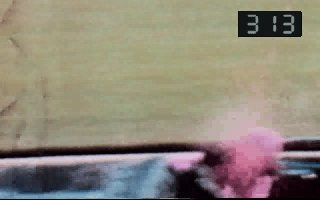
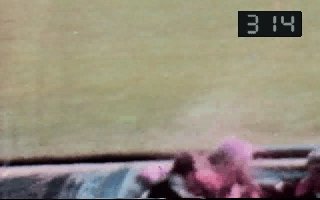
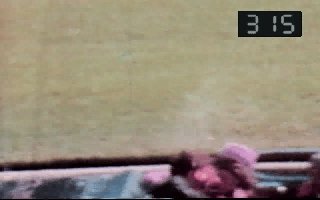
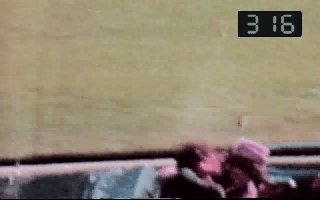
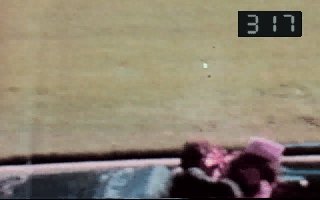
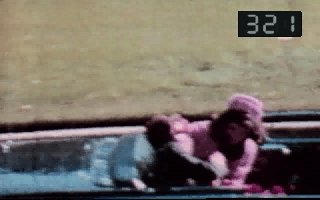
Here are the frames relevant to the lurch, taken as before from John
Masland's web site. They begin with 313, which corresponds to the maximum
forward extent of JFK's head after the snap. They end with 321, just after JFK
has bounced off the rear seat and is beginning the forward movement that will
eventually put him in his wife's lap:
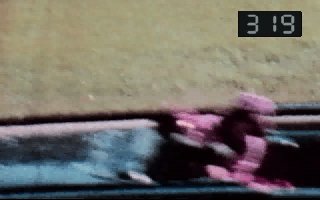
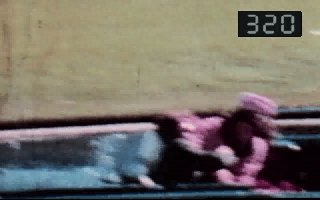
(First draft) This complex motion can be viewed as containing three
components. The first is Mrs. Kennedy's, in which she pulls, no doubt
reflexively, away from her husband's exploding head by recoiling backward (while
straightening up) and to her left. The second is of Mr. Kennedy's right arm and
shoulder, which lift upward as his trunk rotates counterclockwise (leftward)
about his hip, while his upper torso is moving backward and to his left. This
motion continues until his left arm appears to hit the rear seat in about 319,
after which he bounces forward. Third is his head, which moves back steadily
from 313 to about 320 or 321 (one or two frames after his torso has begun to
move forward), all the while rotating counterclockwise faster than his upper
torso, until by about 321 we are given a nearly direct view of the rear of his
head, which incidentally shows no evidence of the massive blowout so often
claimed from the reports of the Parkland medical personnel. The visible damage
is clearly to the right occipitoparietal area of the head, or very roughly in
the upper part of the right rear half of the head (just where the autopsy
physicians placed it). In no way is the damage centered in the rear of the head.
The key point here is that this complex rearward movement is not compatible
with a direct hit of a bullet from the right front. The head does not snap
backward rapidly the way it snapped forward, even though it was perfectly free
to do so. Rather the head starts moving backward slowly and gains momentum over
several frames. There is no cloud of brain matter to the rear as there was to
the front. There is no damage to the left hemisphere of his brain, as there
would have to be with a hit from the right. There is no cone of tiny fragments
going from right to left in the brain, and no exit wound on the left side. No,
the rearward motion was of JFK's entire upper torso, with the head just moving
along with the neck. It is a vicious recoil of sorts from the exploding right
side of his head. Such a movement could have been caused by a mechanical recoil
from the particles that exploded frontward out of his head (the so-called
"jet effect"), by some sort of neurological reaction (sometimes called
a "neuromuscular spasm), or a combination of both. The available data
strongly suggest that it was indeed a combination of effects, whose detailed
contributions will probably never be known with certainty. (See the elaborate
"Physics
of the head shot.")
So we can forget a shot from the front. If there was one (and there is no
physical evidence for it), it certainly didn't hit the President or Mrs.
Kennedy. Unless or until someone produces positive physical evidence for it, we
are not allowed to invoke a frontal shot, period.